
Your CV Shouldn’t Read Like a Job Description: How to Turn Responsibilities Into Achievements
Your CV tells employers what you’ve done. But does it show how well you did it?
Open your CV and look at the experience section.
How many bullet points sound like this?
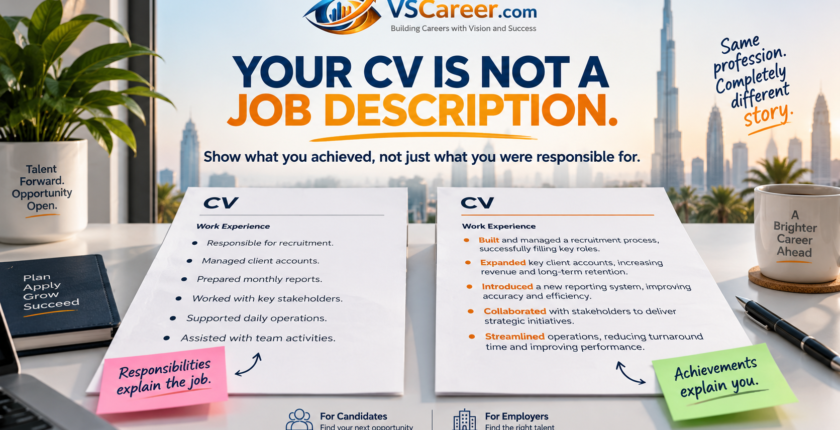
“Responsible for recruitment.”
“Managed client accounts.”
“Prepared monthly reports.”
“Worked with key stakeholders.”
“Supported daily operations.”
There’s nothing technically wrong with these statements.
The problem is that they could describe almost anyone who has held the same position.
Your responsibilities explain the job.
Your achievements explain you.
And when an employer is reviewing multiple candidates with similar job titles and years of experience, that difference becomes important.
Responsibilities and achievements are not the same thing
A responsibility describes what you were expected to do.
An achievement describes what happened because you did it well.
Consider these two examples.
Responsibility:
Managed end-to-end recruitment.
Now compare it with:
Achievement:
Built and managed an internal recruitment process, successfully filling 57 positions across multiple international markets without recruitment agency fees.
Both statements describe recruitment experience.
But the second gives the employer considerably more information.
It shows scale.
It provides context.
It demonstrates ownership.
And most importantly, it gives the employer evidence of what the candidate actually delivered.
That’s what makes an achievement memorable.
The simplest CV test: Ask “So what?”
One of the easiest ways to improve your CV doesn’t require a complicated formula.
Read each major bullet point and ask:
“So what?”
For example:
“Managed a sales portfolio.”
So what?
How many clients? What type of clients? Did the portfolio grow? Did you win new accounts? Did you retain important customers?
“Led a team.”
So what?
How large was the team? What were you responsible for delivering? Did you improve performance? Build the team? Restructure it? Develop people?
“Implemented a new system.”
So what?
Why was it introduced? What problem did it solve? What changed afterwards? Who used it?
Keep asking until the statement tells the reader something about your contribution, rather than simply describing the position you occupied.
Use Action + Scale + Result
A useful framework for rewriting CV bullets is:
ACTION + SCALE + RESULT
You won’t necessarily need all three elements in every sentence, but they provide a useful way to think about your experience.
1. Action: What did you actually do?
Use specific verbs that demonstrate ownership.
Instead of:
Responsible for…
Consider:
Built. Led. Introduced. Created. Delivered. Improved. Launched. Negotiated. Implemented. Developed. Reduced. Expanded.
The objective isn’t to use impressive vocabulary.
It’s to make your contribution clear.
2. Scale: How significant was it?
Context makes achievements more meaningful.
Depending on your profession, scale might include:
Team size, number of hires, countries, markets, clients, projects, locations, revenue responsibility, budget, transaction volume or business units supported.
For example:
“Managed recruitment.”
becomes:
“Managed recruitment across six international markets.”
Immediately, the reader understands more about the complexity involved.
3. Result: What changed?
This is where the achievement becomes particularly valuable.
Perhaps you:
increased revenue,
reduced costs,
shortened a process,
improved customer retention,
filled difficult vacancies,
launched a new function,
improved compliance,
implemented a system,
entered a new market,
or solved a recurring operational problem.
The result answers the employer’s underlying question:
“What value did this person create?”
Not every achievement needs a percentage
This is important.
Candidates are often told:
“Every CV achievement must have a number.”
We disagree.
Numbers can be extremely useful when they’re genuine.
If you increased revenue by 22%, reduced processing time from five days to two, recruited 50 employees, managed a team of 20 or controlled a AED 5 million budget, that context can strengthen your CV.
But don’t manufacture numbers simply because someone told you that every bullet needs a percentage.
Some of the most meaningful professional achievements aren’t easily expressed that way.
Perhaps you:
Built a process that didn’t previously exist.
Opened a new market.
Introduced a new HR or operational system.
Created structure during rapid organisational growth.
Resolved a long-standing employee or customer problem.
Managed an unusually complex stakeholder environment.
Led an organisation through significant change.
These are achievements too.
Credibility is more important than an impressive-looking statistic.
Before and after: Turning responsibilities into stronger CV statements
Here are several examples across different professions.
Human Resources
Before:
Responsible for recruitment.
Stronger:
Managed end-to-end recruitment across multiple international markets, building internal sourcing capability and reducing reliance on external recruitment agencies.
Sales
Before:
Managed key accounts.
Stronger:
Managed and developed strategic client accounts, identifying new commercial opportunities and strengthening long-term customer relationships.
If you have credible revenue or growth figures, add them.
Marketing
Before:
Managed social media channels.
Stronger:
Developed and executed social media content across key channels, introducing a structured content calendar and improving consistency of brand communication.
Operations
Before:
Responsible for improving operational processes.
Stronger:
Reviewed existing operational workflows, identified recurring bottlenecks and introduced standardised processes to improve consistency and accountability.
Finance
Before:
Prepared monthly reports.
Stronger:
Prepared and analysed monthly management reporting, highlighting key variances and providing information to support business decision-making.
Notice something important.
Not every example contains a percentage.
But every stronger version provides more context about contribution and value.
Your CV should answer a bigger question
When an employer opens your CV, they’re rarely interested only in whether you’ve performed a particular responsibility before.
They’re trying to understand something bigger:
“What could this person potentially do for us?”
Your previous achievements provide evidence.
If you’ve built teams before, perhaps you can build one again.
If you’ve improved processes before, perhaps you can identify inefficiencies in the new organisation.
If you’ve successfully developed client relationships, perhaps you can do the same in a new market.
If you’ve implemented systems, opened markets or managed complex projects, those experiences tell employers something about your ability to solve problems.
That’s why achievements matter.
They turn experience into evidence.
But don’t turn your CV into fiction
There is another side to achievement-focused CV writing.
Don’t exaggerate.
Don’t invent percentages.
Don’t increase team sizes.
Don’t claim revenue you didn’t generate.
Don’t turn participation into leadership.
And don’t let an AI CV tool manufacture achievements simply because they sound impressive.
A strong CV doesn’t need to make you appear perfect.
It needs to make your real value easier to understand.
You should be comfortable discussing and defending every achievement during an interview.
If you can’t explain where a number came from, it probably shouldn’t be on your CV.
What GCC candidates should consider
If you’re applying across the UAE, Saudi Arabia, Qatar, Oman, Kuwait or Bahrain, context can be particularly useful.
GCC employers may be reviewing candidates from very different markets, company sizes and professional environments.
Simply writing:
“HR Manager – 7 years”
or:
“Sales Executive – 5 years”
doesn’t necessarily explain the complexity of that experience.
Where relevant, show:
the markets you’ve covered,
the industries you’ve worked in,
the scale you’ve managed,
the languages or stakeholder groups you’ve worked with,
the systems you’ve implemented,
and the business outcomes you’ve contributed to.
International experience doesn’t need to be hidden.
It needs to be translated into value the employer can understand.
A 10-minute CV exercise you can do today
Open your current CV.
Go directly to your most recent position.
Find the first five responsibility statements.
For each one, ask:
What did I actually do?
At what scale?
What changed because of my work?
What made this difficult or significant?
What evidence can I provide?
Then rewrite just those five bullets.
You may be surprised by how different your experience looks when you stop describing the job and start describing your contribution to it.
Your responsibilities explain the job. Your achievements explain you.
Your job title gives employers context.
Your responsibilities tell them what you were expected to do.
But your achievements show them something considerably more valuable:
what happened when you were trusted to do it.
So before submitting your next application, read your CV one more time and ask:
“Does this describe my job or does it demonstrate my value?”
That distinction could change the way an employer reads your application.
Build your next career move with VSCareer.com
VSCareer.com connects candidates and employers across the GCC, helping professionals discover relevant opportunities and employers identify talent more effectively.
For candidates: Keep your profile and CV up to date and explore opportunities across the GCC.
For employers: Post vacancies, manage applications and use AI-assisted matching and shortlisting to identify relevant candidates more efficiently.
VSCareer.com
Building careers with Vision and Success.
Talent Forward. Opportunity Open.