
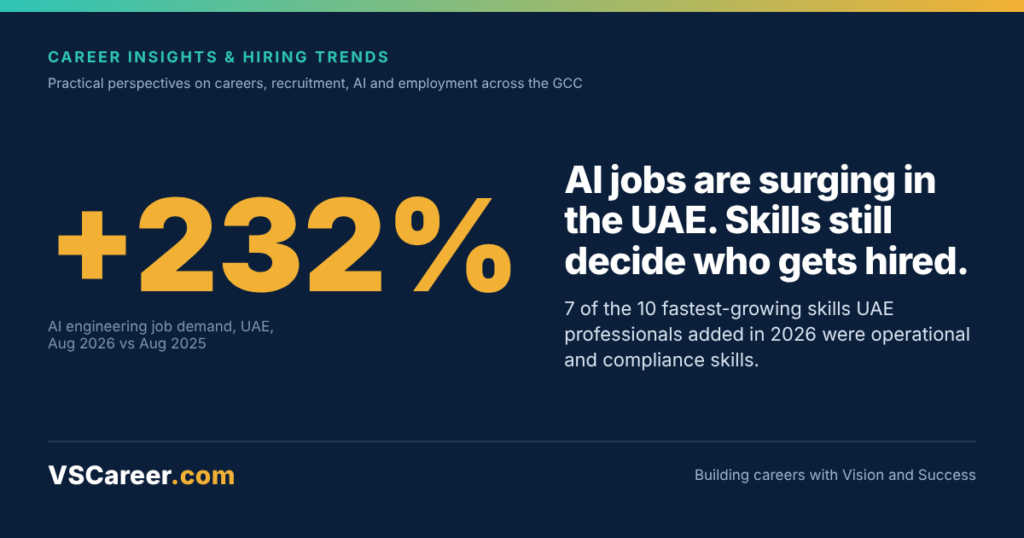
AI Engineering Demand Is Up 232% in the UAE. Skills, Not Titles, Still Decide Who Gets Hired
Career Insights & Hiring Trends: practical perspectives on careers, recruitment, AI and employment across the GCC.
The headline number from LinkedIn’s first UAE Workforce Readiness Report is hard to miss: demand for AI engineering roles in the UAE rose 232.4% year on year in August 2026. But the more useful story sits underneath. Most of the skills growing fastest among UAE professionals are not about AI at all: they are compliance, reporting, cost control and coordination. And people moving into the country’s priority sectors come from a very wide mix of previous jobs.
For Gulf employers and job seekers, that matters more than any single statistic.
What the data shows
According to the report, as summarised by People Matters Middle East:
- UAE hiring fell to 40% below 2025 levels in April 2026, amid regional conflict and economic uncertainty. By August the gap had narrowed to 18%.
- In August, 15 of the UAE’s 17 major industries recorded month-on-month hiring growth, although all of them were still below August 2025 levels.
- Demand for AI engineering roles rose 232.4% year on year in August. These roles made up 4.1% of LinkedIn job postings in the UAE.
- Four of the UAE’s 10 fastest-growing occupations were AI-specific, including AI engineer, AI consultant, head of AI and manager of AI.
- AI literacy talent concentration rose 113.7% year on year; AI engineering talent concentration rose 27%.
- Seven of the 10 fastest-growing skills that UAE members added to their profiles in 2026 were operational or compliance-related, such as Compliance Operations, Regulatory Audits, Executive Reporting and Reducing Operating Costs.
- Among workers moving into six priority sectors (including financial services, construction, logistics and healthcare), no single previous occupation accounted for more than 3.5% of transitions.
Ali Matar, Head of LinkedIn MENA and EMEA and LATAM Growth Markets Leader, said the strongest labour markets are those that “can adapt early.”
Why it matters for the GCC job market
The report shows demand for AI talent rising quickly. Other recent regional research shows that the wider workforce is still catching up.
A study by Al-Futtaim, released on 22 October 2026, surveyed 1,143 professionals across six GCC markets. It found that 82% use AI daily or at least weekly, but only 39% describe themselves as highly confident with it. Only around one in five said they had received extensive AI training, and one in four said their employer had given them no formal AI instruction at all. Employees with extensive training were 2.5 times more likely to report high confidence. Moza Al Futtaim, the group’s chief AI officer, said the opportunity now is “to match that momentum with readiness.”
Trust in AI hiring is a separate issue. The Q3 2026 GCC People Pulse from EXE and Ipsos, based on 1,700 employees in the UAE, Saudi Arabia, Kuwait and Qatar, found that 59% would take part in an AI-led screening interview, but only 44% are comfortable with AI making the final decision on a job application. 42% said they would withdraw from a process if they found their application was being decided by AI.
The message is consistent: AI is reshaping what employers look for, but skills, training and trust are where hiring is won or lost.
A note on the data: the LinkedIn report covers the UAE only and is based on LinkedIn’s own platform data, so it reflects people and employers active on LinkedIn. The report itself notes that skills members add to their profiles are self-reported, not verified. The EXE and Ipsos survey did not include Bahrain or Oman.
What employers should do
- Write roles around skills, not titles. List the capabilities the job truly needs. If transitions into priority sectors come from so many backgrounds, a title filter will screen out good candidates.
- Recruit from adjacent occupations. The report points to pathways from accounting, sales, customer service, project management and engineering into growing sectors. Build those routes into your sourcing and internal moves.
- Keep people in charge of people decisions. Use AI to support screening and matching, train recruiters to use it well, tell candidates where it is used, and leave the final call with a person.
What job seekers should do
- Make AI literacy visible. Show one task you improved with AI tools instead of just listing “AI” as a skill.
- Lead with execution. Compliance, reporting, cost savings and coordination are growing skills. Quantify what you delivered.
- Translate your experience for the next sector. Map what you did, not what you were called. Your move may well come from an adjacent role.
The bottom line
AI roles are growing fastest, but they remain a small share of UAE postings. The broader shift is towards skills: technical where needed, operational almost everywhere, transferable across sectors. Employers who hire on that basis widen their talent pool. Job seekers who describe their work in skills and results become easier to find.
That is also the idea behind VSCareer.com: matching people on skills and experience, with AI tools that support human hiring decisions rather than replace them.
This week’s question: Is your organisation really hiring for skills, or still screening by job title first? Join the discussion on our LinkedIn page: https://www.linkedin.com/company/vscareer-com/
Building careers with Vision and Success.
Sources
- People Matters Middle East, “UAE hiring recovers from April low, but remains below 2025 levels: LinkedIn report” (17 November 2026): https://me.peoplemattersglobal.com/news/recruiting-and-onboarding/uae-hiring-recovers-from-april-low-but-remains-below-2025-levels-linkedin-report-53399
- People Matters Middle East, “Al-Futtaim study: 61% of GCC professionals lack high confidence in using AI” (27 October 2026): https://me.peoplemattersglobal.com/amp/news/ai-and-emerging-tech/al-futtaim-study-finds-ai-skills-gap-as-82percent-of-gcc-professionals-use-technology-weekly-53000
- Business Today Middle East, “GCC Employees Embrace AI as a Workplace Tool – But Draw the Line at Letting It Make Decisions About People” (15 October 2026): https://businesstoday.me/analysis/gcc-employees-embrace-ai-as-a-workplace-tool/