
GCC Workforce Brief | November 2026: Saudisation, Emiratisation and Workforce Compliance Deadlines
Published 25 November 2026 · GCC Workforce Brief, Edition 2
November brought new workforce requirements and important compliance deadlines across the GCC. Saudi Arabia began enforcing its sports Saudisation quota and announced new quotas for engineering technicians and financial professions. The UAE is approaching its year-end Emiratisation deadline, while Oman and Kuwait have stepped up labour-market oversight. Employers in Qatar and Bahrain also need to apply rule changes introduced in September.
Each month, the GCC Workforce Brief picks the labour and hiring rule changes across the Gulf that matter most to employers and HR teams, and explains what changed, who it affects and what to do next. Here’s what you need to know for November.
Saudi Arabia: one quota live, two on the way, and a housing deadline
Gyms and sports centres: 15% Saudisation is now enforced. Since 18 November, private gyms and sports centres with four or more workers in 12 sports professions must fill at least 15% of those roles with Saudis. The roles include sports coaches, fitness and personal trainers, sports supervisors, and coaches for football, racket sports, water sports, athletics, equestrian sports, self-defence and other disciplines, in both men’s and women’s centres. The Ministry of Human Resources and Social Development (MHRSD) says inspection teams are checking compliance.
Engineering technicians: 35% from 9 May 2027. On 8 November, MHRSD and the Ministry of Municipalities and Housing announced a 35% Saudisation rate for 94 engineering technical professions. It applies to establishments with five or more workers in those roles, counted across the whole establishment. The roles include civil, electrical, mechanical and electronics engineering technicians, surveying technicians, mechanical maintenance technicians and architectural draftsmen. Check occupation codes and any professional accreditation required under the ministry’s procedural guide, as these decide who counts toward the quota.
Financial professions: 50% from 23 May 2027. On 22 November, MHRSD and the Saudi Organization for Chartered and Professional Accountants (SOCPA) announced a 50% Saudisation rate for 17 financial professions. It applies to private-sector establishments with two or more workers in those roles, under the occupational classifications in the procedural guide. The 50% is calculated across all the targeted financial occupations together, for the establishment as a whole, not as a separate quota for each of the 17 roles. The roles include financial analysis and consulting specialists, investment managers and specialists, financial control and planning specialists, treasury specialists and credit managers.
Worker housing: the final phase starts 1 February 2027. Saudi Arabia’s collective-housing requirements apply to establishments with 20 or more workers, subject to the applicable workforce and accommodation criteria. The National Program for the Development of Collective Housing has confirmed that establishments with fewer than 250 targeted workers must comply with the final implementation phase beginning 1 February 2027.
Employers can either license accommodation that meets the required standards or contract licensed collective-housing providers. For workers covered by the requirements, paying a housing allowance does not replace the obligation to provide compliant accommodation.
What to do now
- If you run gyms or sports centres, check today that 15% of covered roles are held by Saudis. Inspections have started.
- Map engineering technician and financial roles against the listed occupation codes and start building Saudi pipelines for both. Six months is short for technical hiring.
- Audit worker housing now. Decide whether to license your own building or contract a licensed provider before 1 February.
UAE: five weeks to the Emiratisation deadline, and a reminder on discipline
The 31 December deadline is close. On 30 October, the Ministry of Human Resources and Emiratisation (MoHRE) urged companies with 50 or more workers to meet their 2026 targets. They must add 1% Emiratisation growth in skilled jobs in the second half of the year, on top of 1% in the first half: 2% for 2026, taking the cumulative target to 10%. For 2026, the financial contribution is calculated at AED 10,000 a month, equivalent to AED 120,000 a year, for each unfilled Emirati position, subject to MoHRE’s compliance assessment and collection arrangements. Emiratis must be genuinely employed, registered for pension and paid through approved wage channels to count.
A clarification on disciplinary penalties. In mid-November, MoHRE clarified how employers should apply the disciplinary rules already in the Labour Relations Law and its Executive Regulations. This is guidance on existing rules, not a new law. Before any penalty, you must notify the worker in writing, allow them to respond, and record the proceedings. Only one penalty is allowed per violation, and it must be proportionate to what happened. Penalties range from a written warning to dismissal, with end-of-service benefits protected where the law requires.
What to do now
- Count your skilled Emirati headcount today against the 31 December target. Use Nafis to fill gaps rather than hiring in the last week.
- Verify that Emirati employees have genuine roles, are registered with the applicable pension authority where required, and are paid through the legally applicable payment system. Fictitious Emiratisation is a compliance violation.
- Update your disciplinary policy: written notice, a chance to respond, a written record, one penalty per violation.
Qatar, Bahrain, Oman and Kuwait: payroll, mobility and enforcement
Qatar: a reminder on payroll deadlines. Minister of Labour Decision No. 50 of 2026, in force since 8 September 2026, amended the Wage Protection System rules. Wages for workers paid monthly or annually are due on the first day of each month and must reach the worker’s account at a financial institution in Qatar through WPS within seven days. Wages for all other workers are due on the first day of every two-week period. With year-end payroll and bonuses coming up, it’s a good moment to check you’re compliant.
These deadlines apply to mainland companies under Qatar’s Labour Law. Companies in the Qatar Financial Centre (QFC) follow the QFC’s own Employment Regulations and are not required to pay through WPS. For Qatar Free Zones, the Free Zones Authority’s March 2024 draft Employment Regulations proposed not applying WPS and using alternative measures to protect wages. That was a draft, though, and we couldn’t confirm final regulations, so free zone employers should check their current obligations with the Authority.
Recruitment agencies: the clock is running. Decision No. 61 of 2026 took effect on 26 October. Agencies have an initial three-month adjustment period, which points to late January 2027, although the Minister may extend it.
Bahrain lets employers share workers for up to three months. Under LMRA Resolution No. 2 of 2026, which amends the 2008 work permit rules, a foreign worker can work temporarily for a second employer for up to three months. For deployment to another employer, LMRA must approve the arrangement before the worker starts, and it needs the worker’s written consent and both employers’ agreement. If that employer has a lower Bahrainisation requirement, it pays an extra fee. The resolution also allows temporary deployment to another establishment owned by the same employer or in the same group, under separate conditions, including that the receiving establishment’s Bahrainisation requirement is the same or higher. When a worker is deployed to another employer, both employers are jointly responsible for the worker’s employment rights during the assignment. Bahrain’s parliament has also backed proposals for higher permit fees in some professions and mandatory vacancy reporting. These are not law yet, but worth watching.
Oman cracks down on paper Omanisation. On 7 November, the Ministry of Labour warned against fictitious employment: registering Omanis who don’t actually work, to inflate Omanisation figures. It is monitoring hiring indicators and WPS data. On 10 November it set out the process. When an Omani employee leaves whose hiring helped the company meet Omanisation targets or qualify for reduced labour fees, the company has 40 days to hire a replacement. If the vacancy remains unfilled, the ministry issues a notice after 45 days and allows 15 more days to comply. Continued non-compliance may lead to an OMR 500 fine under the ministry’s enforcement process. Cases are reviewed individually, and genuine field, part-time, remote and freelance roles are taken into account. Separately, on 10 November, Oman issued the laws that set up the International Financial Centre of Oman, so firms planning to operate there should check which rules will apply to their staff. Oman’s new recruitment agency rules still take effect on 1 January 2027.
Kuwait: labour inspections and recruitment cooperation. On 7 November, the Public Authority for Manpower (PAM) said it had inspected more than 70 establishments in Hawalli with the Interior Ministry. According to PAM, teams checked for labour law violations and indicators of forced labour, and issued notices requiring employers to fix the issues found. PAM says these campaigns will continue. Kuwait also approved a labour agreement with Tajikistan (Decree No. 176 of 2026) covering private-sector recruitment and worker protections. The agreement is approved but not yet operational: it takes effect only once both governments complete their notification procedures, so it doesn’t change recruitment today.
What to do now
- For Qatar Labour Law employees paid monthly or annually, verify that wages are transferred through WPS into accounts at financial institutions in Qatar within seven days of the due date. Check the separate fortnightly due dates for other workers.
- In Bahrain, check whether temporarily deploying an existing, authorised foreign worker fits a short-term need. For deployment to another employer, get LMRA approval, the worker’s written consent and both employers’ agreement before the assignment begins, and confirm the Bahrainisation conditions.
- In Oman, verify that registered Omani employees hold genuine roles. Where an employee’s hiring counted toward Omanisation incentives, track the 40-day replacement period after they leave.
- In Kuwait, review labour records, worker accommodation and safety before the next inspection.
- If you hire through agencies in Qatar or Oman, confirm they will meet the new rules before your next contract renewal.
Dates to watch
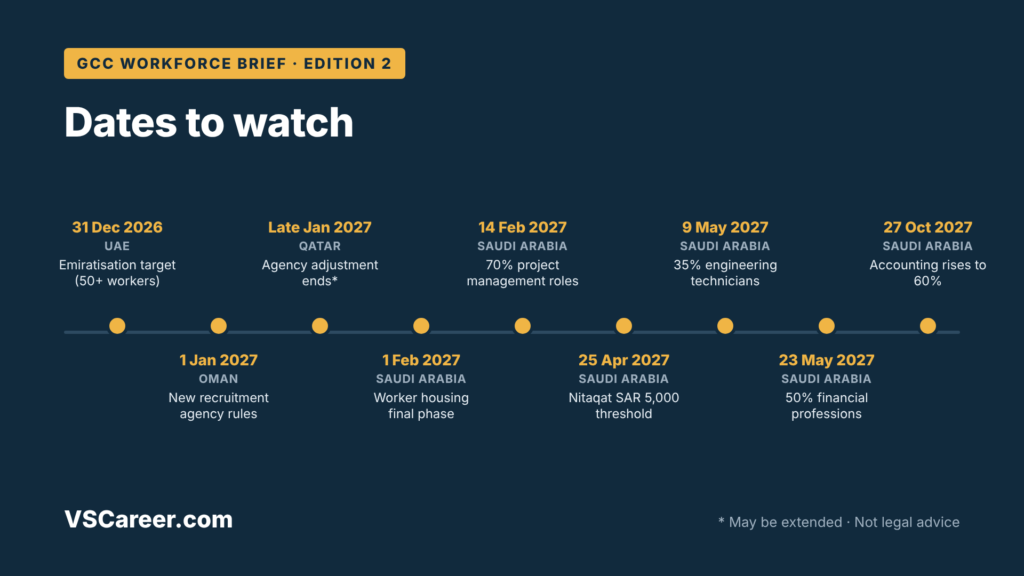
- 31 December 2026 – UAE: 2026 Emiratisation target for companies with 50+ workers
- 1 January 2027 – Oman: new recruitment agency rules take effect
- Late January 2027 – Qatar: recruitment agencies’ initial three-month adjustment period ends (may be extended)
- 1 February 2027 – Saudi Arabia: final phase of worker housing rules
- 14 February 2027 – Saudi Arabia: 70% Saudisation for project management roles
- 25 April 2027 – Saudi Arabia: Nitaqat salary threshold for full Saudisation counting rises to SAR 5,000
- 9 May 2027 – Saudi Arabia: 35% Saudisation for 94 engineering technician roles
- 23 May 2027 – Saudi Arabia: 50% Saudisation for 17 financial professions
- 27 October 2027 – Saudi Arabia: accounting Saudisation rises to 60%
The bottom line
The common thread this month: quotas are spreading from office roles into technical and frontline jobs, and compliance now reaches payroll timing and worker housing too.
If you’re hiring across the GCC, VSCareer.com matches you with candidates on skills and experience, not just job titles, with CV search and an AI hiring assistant to help you shortlist. Register as an employer at vscareer.com.
Want this every month? Subscribe to the GCC Workforce Brief on LinkedIn.
This article is for general information only and is not legal advice. Always check the official guidance for your situation.
Sources
- Saudi Arabia begins enforcing 15% Saudisation in 12 sports professions – Gulf News
- Saudisation of 94 engineering technical professions raised to 35% (Arabic) – Ministry of Human Resources and Social Development
- Saudi Arabia announces 50% Saudization of 17 financial professions starting May 2027 – Saudi Gazette
- Saudi Arabia raises minimum Nitaqat salary threshold for Saudi employees – EY
- Establishments with fewer than 250 targeted workers must provide licensed collective housing from February 2027 (Arabic) – Ministry of Municipalities and Housing
- Establishments with 20 or more workers called to license collective housing (Arabic) – Balady
- Qiwa: shared housing mandatory for establishments with 20+ workers – Saudi Gazette via PressBee
- MoHRE urges private sector to meet Emiratisation targets for 2026 – Sharjah24
- MoHRE warns UAE firms ahead of June 30 Emiratisation deadline – Gulf News
- UAE introduces new rules to ensure fairness in worker disciplinary penalties – Gulf News
- Qatar amends WPS salary payment deadlines, effective 8 September 2026 – EY
- Draft Employment Regulations, Consultation Paper 2024/01 – Qatar Free Zones Authority
- LMRA announces Resolution No. 2 of 2026 on temporary use of foreign workers (Arabic) – Labour Market Regulatory Authority, Bahrain
- Bahrain expands foreign worker usage rules – Envoy Global
- Ministry warns against fictitious employment (Arabic) – Ministry of Labour, Oman, 7 November
- Replacement process and OMR 500 fine – Ministry of Labour, Oman, 10 November
- HM issues four Royal Decrees – Oman Observer
- PAM inspection campaign in Hawalli (Arabic) – Al-Jarida; same report (Arabic) – Al-Anba; Joint Hawally campaign inspects more than 70 establishments – Arab Times
- Kuwait, Tajikistan approve agreement to facilitate private-sector labour recruitment – Times Kuwait
Building careers with Vision and Success.